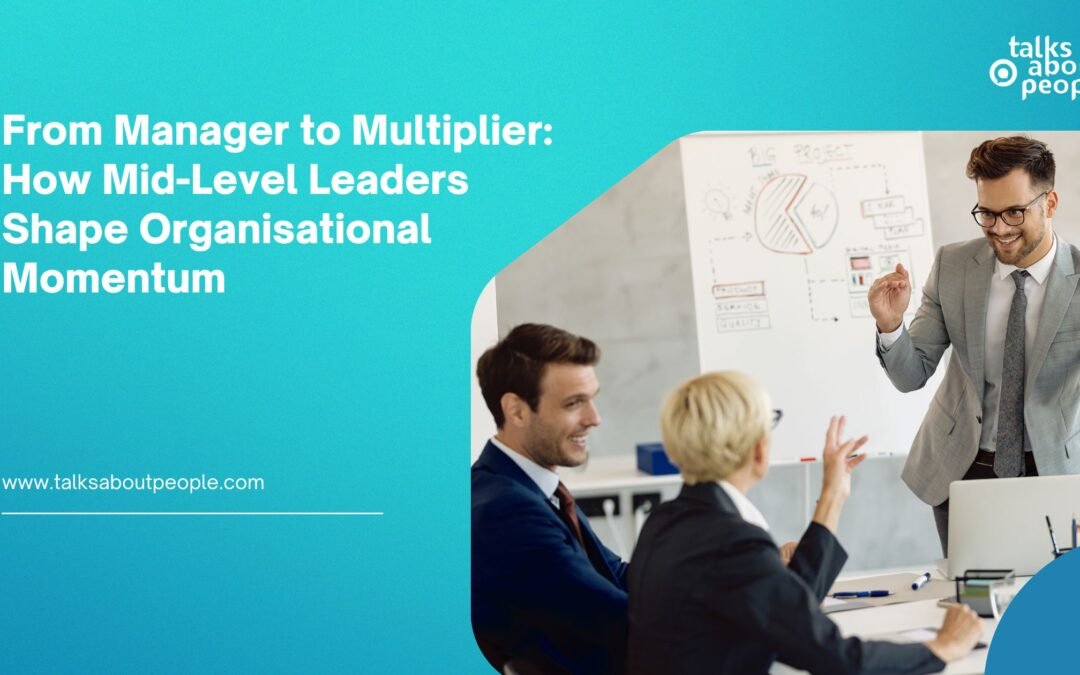
The top sets strategy and bottom executes. But momentum, the consistent, compounding force driving sustainable growth, develops in the middle.
Senior leaders in organisational growth typically face an excessive cognitive load (constant reprioritisation, high-stakes decision making, and trade-offs across multiple functions).
Many leaders silently experience decision fatigue (the overwhelming sense of being constantly “under pressure”) due to their strategic thinking becoming reactive instead of a deliberate process, thereby creating slow-moving organisations.
The solution is not a better strategy but rather creating stronger mid-level leadership development.
Managers are able to evolve into “multipliers” (i.e. converting exponential growth) through absorbing complexity, distributing responsibility, and reducing decision fatigue for senior leadership at the top. In doing so, they translate vision into action.
Who Are Mid-Level Leaders & Why They Matter More Than Ever
Mid-level leaders sit at the intersection of strategy and execution.
They include:
- Functional heads
- Regional managers
- Business unit leaders
- Senior project managers
- Departmental leads
Their role is inherently dual-facing:
- Translate strategic priorities into operational action
- Report outcomes upward while guiding teams downward
- Align cross-functional efforts laterally
In today’s environment, marked by hybrid teams, faster execution cycles, and talent mobility, this layer carries disproportionate influence.
They are not just supervisors of output.
They are curators of clarity.
When mid-level leadership development is strong:
- Execution accelerates
- Escalations reduce
- Teams take ownership
When it is weak, senior leaders are pulled into tactical decisions repeatedly, amplifying decision fatigue in leadership and diluting strategic focus.
Organisations that understand this layer’s leverage invest in its depth, not as a support function, but as a growth engine.
The Shift: From Manager to Multiplier
The distinction between a traditional manager and a multiplier leader is subtle, but transformative.
The Traditional Manager:
- Focuses on task completion
- Centralises problem-solving
- Approves decisions
- Controls processes
The Multiplier Leader:
- Builds decision-making capability in others
- Clarifies outcomes, not just tasks
- Encourages distributed accountability
- Removes friction, not autonomy
The multiplier does not add effort. They increase organisational capacity.
In scaling companies, hierarchies cannot expand as quickly as complexity. If every critical decision must rise upward, decision fatigue in leadership becomes inevitable. Momentum stalls not because talent is lacking, but because decision rights are not distributed.
Mid-level leadership development produces individuals who act as multipliers, absorb ambiguity, resolve operational friction, and empower teams to act confidently. This reduces unnecessary escalations and preserves executive bandwidth for high-leverage decisions.
The shift from manager to multiplier is not cosmetic. It is structural.
How Mid-Level Leaders Shape Organisational Momentum
Momentum is not built through vision statements. It is built through consistent, aligned execution. Mid-level leadership development can influence this in four critical ways.
1. They Accelerate Strategy Execution
Strategic plans often fail in translation. Mid-level leaders ensure alignment by:
- Breaking strategy into measurable priorities
- Clarifying ownership
- Identifying execution gaps early
- Anticipating operational risks
When this layer is decisive and aligned, senior leadership is shielded from constant tactical reviews. Decision fatigue in leadership reduces because clarity travels downward, not confusion upward.
2. They Shape Culture in Action
Culture is not built in annual town halls. It is reinforced in weekly reviews and daily interactions.
Mid-level leadership development can define:
- Performance standards
- Feedback quality
- Psychological safety
- Accountability norms
If they tolerate mediocrity, it spreads. If they reinforce excellence, it compounds.
More importantly, they model decision behaviour. When they take ownership and empower their teams, they prevent small uncertainties from escalating upward. This reduces cumulative decision fatigue in leadership.
3. They Determine Talent Retention and Leadership Pipeline
Talent rarely disengages because of the company vision. It disengages because of immediate leadership.
Mid-level leadership development produces leaders who:
- Coach emerging talent
- Spot potential early
- Provide stretch opportunities
- Offer developmental feedback
When this layer lacks leadership maturity, organisations face attrition, stalled succession pipelines, and dependency on external hiring.
Conversely, multiplier leaders create future leaders. They build depth. They reduce fragility.
For firms like Talks About People (TAP), which specialise in leadership hiring and strategic talent advisory, evaluating this multiplier capacity is essential.
Functional competence alone is insufficient. Leadership influence must be assessed with equal rigour.
4. They Drive Cross-Functional Alignment
Modern organisations are matrixed and interconnected. Silos are expensive.
Mid-level leaders operate across boundaries by:
- Aligning shared metrics
- Facilitating interdepartmental clarity
- Managing stakeholder expectations
- Preventing duplication of effort
When this layer collaborates effectively, organisational velocity increases. When it competes internally, senior leaders are forced into arbitration roles. These roles have a significant role to play in compounding decision fatigue in leadership.
Alignment in the middle protects clarity at the top.
Why Organisations Often Overlook This Layer
Despite its impact, mid-level leadership is frequently underdeveloped.
Common patterns include:
- Over-investing in CXO hiring while neglecting leadership depth below
- Promoting high performers without assessing leadership readiness
- Measuring performance only by output, not influence
- Lacking structured succession planning for mid-management roles
The result? Senior leaders become operational bottlenecks.
Without a strong multiplier layer, strategic leaders are drawn into daily approvals, conflict resolution, and micro-decisions. Over time, decision fatigue in leadership erodes judgment quality and slows innovation.
Organisations rarely intend this outcome. It emerges gradually through the underestimation of this layer’s leverage.
Building a Multiplier Layer: What Organisations Must Do
Strengthening mid-level leadership requires intentional design.
1. Hire for Leadership Potential, Not Just Technical Excellence
Functional mastery does not automatically translate to influence. Behavioural assessment, stakeholder management ability, and decision maturity must be evaluated.
2. Invest in Structured Leadership Development
Equip mid-level leaders with:
- Strategic thinking frameworks
- Conflict management skills
- Cross-functional exposure
- Decision-making autonomy
3. Align Incentives with Ownership
Reward collaboration, problem-solving, and team development, not only individual output.
4. Assess Impact Holistically
Evaluate:
- Team engagement levels
- Escalation frequency
- Cross-functional effectiveness
- Succession readiness
This is where leadership search and advisory partners play a strategic role. At TAP, leadership evaluation extends beyond CV screening.
It includes understanding behavioural patterns, organisational fit, and multiplier capability, especially within mid-management roles that shape long-term momentum.
When organisations treat this layer as strategic capital rather than an operational necessity, scalability becomes more predictable.
Momentum Is a Leadership Design Choice
Organisations do not slow down because ideas are weak.
They slow down because leadership bandwidth is stretched.
Unchecked decision fatigue in leadership is often a signal, not of incapacity, but of insufficient leadership depth beneath.
When mid-level leaders evolve from managers to multipliers:
- Decisions distribute intelligently
- Execution accelerates
- Culture strengthens
- Talent compounds
Momentum becomes structural, not accidental.
For organisations seeking sustainable scale, the question is not whether they have strong senior leaders. It is whether they have built a multiplier layer capable of sustaining growth.
Talks About People partners with organisations to identify, evaluate, and build leadership depth across critical layers; not just at the top, but where momentum is truly shaped.
If your organisation is scaling and you’re experiencing invisible friction, it may be time to examine the strength of your middle.
Because growth is not powered by vision alone.
It is multiplied by leadership.